
The Role of a Stepparent in an LDS Blended Family

What is the role of a stepparent in a blended family? There is no single role that fits every family. In most cases, however, stepparents function best in a supportive rather than primary parenting role—especially early in the family's development. That doesn't make their contribution less important. It simply recognizes that stepparent authority develops differently from biological-parent authority and usually grows through relationship, trust, and time.
In this article, learn about role ambiguity, the difference between authority and responsibility, and how adopting a supportive position can be so vital to stepfamily functioning.

Why Stepparent Roles Can Feel So Ambiguous
Role ambiguity is a term that refers to the confusion or uncertainty stepparents often have about their role in the family:
Are they a parent, friend, or something in between?
How involved should they be in their stepchildren’s lives?
Does their role change over time or differ with individual children?
How much say should they have in decisions that affect them?
For Latter-day Saint stepfamilies, the questions become even more complicated when couples consider teaching about the roles of mothers and fathers In The Family Proclamation:
How should a stepfather fulfill the role to preside, provide and protect in a blended family?
Are these roles different with stepchildren than biological children?
How can a stepmother fulfill the role of nurturer, especially if her stepchildren resist her involvement?
Should a stepmother take over the role of nurturer as soon as the blended family forms?
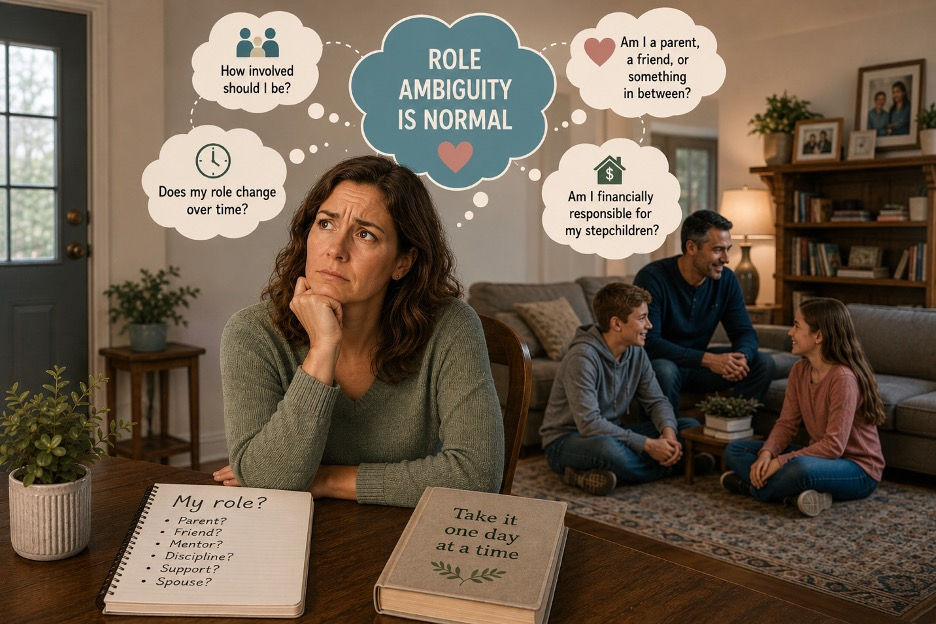
The most accurate answer to many questions about stepparent roles is, “It depends.” A child's age and personality, time spent in each household, the parenting styles of the adults, the strength of the stepparent-stepchild relationship, and how long the family has been blending all influence what role a stepparent can successfully assume. Feeling some ambiguity is normal, particularly early on. It’s important for stepparents to be patient with themselves as they tentatively navigate their way forward. And it’s important for biological parents to acknowledge their spouse’s struggles and efforts – extending patience and support instead of pressure and criticism.
Responsibility vs Authority in Stepparenting
Sometimes biological parents hand over the responsibility for parenting to a new spouse soon after remarrying. This may seem to put the stepparent in the primary parenting position, but in many cases while the stepparent is given responsibility for children, they lack authority to carry out the associated tasks successfully. It’s helpful to recognize the difference between responsibility and authority, and why both are necessary for parenting to be effective.
Responsibility means being accountable for a task; authority is the legitimate power or influence needed to carry it out. The distinction matters because stepparents are sometimes given substantial responsibility for children before they have developed sufficient relational authority with them.
Biological parents have inherent/legal authority that stepparents generally lack. However, stepparents can develop relational authority over time through trust, respect, connection, and support from the biological parent.
Authority comes when a bond is formed between the stepparent and stepchild, and when trust is present – both in the stepparenting and marital relationships.
New Stepparents Start with Clearly Defined, Limited Authority
Typically when a blended family first forms, it is wise for a stepparent to adopt a nanny or babysitter role in regard to responsibilities for their stepchildren. When a parent hires a caregiver for their children, they communicate clear expectations regarding rules, consequences, and authority to both the caregiver and the children. Similarly, expectations should be clearly communicated when a biological parent “loans” their parental authority to their child’s stepparent.
The children understand what is expected of them (what the rules are), what will happen if they disobey the rules (consequences), and who has the authority to enforce the rules and under what circumstances. It should be clear whether the stepparent has authority to render immediate consequences or whether the rules will be enforced when the parent returns.

A stepparent’s authority is undermined if a parent doesn’t follow through with consequences when their children break pre-determined rules while under their care, or if they undermine the stepparent’s well-intentioned actions taken using their best judgment and understanding of the rules during the time that the children are their responsibility. It is vital that the parents support their partner in front of the children while discussing disagreements privately.
Why Stepmoms May Feel Pressure to Nurture
Stepmothers often experience disproportionate pressure to nurture and manage the day-to-day care of their stepchildren. This is even more common in stepfamilies with young children and/or when biological fathers are the custodial parent.
Furthermore, there is a cultural expectation – both within the Church and within most first world nations – that women are primarily responsible for caring for children and maintaining relationships. Even when stepmothers are able to maintain healthy boundaries in their roles and the expectations others place on her, they often feel guilt or pressure due to these cultural norms.
Many stepmothers love their stepchildren and their maternal roles – whether they have children of their own from prior relationships or they were single prior to forming their stepfamily. I personally found it difficult to distinguish between my responsibilities as a mother of my own biological children and as a stepmom for my youngest stepdaughter. I was truly baffled when, at the conclusion of a custody dispute, the child custody evaluator listed in her recommendations that I learn the difference between the two roles. How was one supposed to care for a five-year-old differently as a stepmother than a mother? Don’t you just love them? To this day, one of my biggest stepfamily regrets is pulling away from my stepdaughter for a time because I thought I was “doing it wrong.”
What Does The Family Proclamation Mean for Stepfathers?
Although perhaps not as pronounced as those for women, men also have cultural pressures to assume certain roles and perform specific responsibilities. As mentioned in the first section, The Family Proclamation states that “by divine design, fathers are to preside over their families in love and righteousness and are responsible to provide the necessities of life and protection for their families (emphasis added).”
How does this apply to stepfathers? There is no “one-size-fits-all” answer, but we can briefly evaluate each:
Preside:
In the teachings of The Church of Jesus Christ of Latter-day Saints, presiding is less about exercising authority than accepting responsibility. A husband presides by leading his family toward Christ through love, service, protection, and spiritual stewardship while counseling with his wife as an equal partner in all family decisions.[1]
Provide:
A stepfather's financial responsibilities for stepchildren differ from those of their biological or legal parents and can vary by family circumstances. Rather than assuming there is one “right way” to manage stepfamily finances, couples can counsel together about how to apply gospel principles to care equitably for the needs of everyone in the household.
Protect:
Protection involves covering or shielding from danger or injury, defending, guarding, and preserving in safety. A father is given this responsibility for individual family members as well as the family as a whole. Appropriate boundaries can create conditions of safety and clarify the father’s responsibilities for protecting his family. This can be especially helpful if conflict arises between individual members of a blended family.
As with stepmother roles, stepfathers can most effectively fulfill their roles and responsibilities through counseling together as husband and wife.
Stepparent Roles Evolve Over Time
It is important for remarrying couples to discuss the role and expectations the stepparent will adopt when the blended family forms. Ideally, this happens before the marriage. But it’s never too late to have a conversation.
This discussion is not a one-time event, but should be ongoing, because roles and expectations are constantly evolving. As children age and their needs change, so will the stepparent’s role. And as the stepparent-stepchild bond increases, the role will also expand to include greater responsibilities and authority.

The Power of a Supportive Stepparent Role
Years ago, a young man in our ward gave a talk in Sacrament Meeting. He was passionate about basketball, but he was the smallest member of the team. The night before a big game, he prayed to have the best game of his life. Although his team won, he was disappointed to have only scored 4 points. But that changed when the coach recognized him during the next practice – congratulating him on having 20 rebounds. This young man said he had been so focused on making the points that he didn’t realize the way his unique talents were benefiting the team.
In blended families, stepparents can easily get distracted and disappointed if they only focus on “scoring points”– on being the star of the team – the one who gets the accolades and the rewards. The young man in my ward used his talents to rebound. Other players may contribute their talents in guarding or assisting. These positions are as necessary for the success of the team as the player who scores the most points.
In many blended families, the stepparent’s most effective role is a supportive one, while the biological parents retain primary parenting responsibility. This does not devalue the stepparent’s role and contribution. Support is not secondary in importance – it is simply a different position on the team.
FAQ: What if the Other Biological Parent Undermines the Stepparent?
Q: My husband and I agree on my role with my stepdaughter, but her biological mother undermines our rules and criticizes me to her. My stepdaughter has become increasingly defiant, and our once-close relationship is suffering. What should I do?
A: If possible, I would suggest your husband schedule a coparenting meeting with his daughter’s mom to discuss these concerns and hopefully create an amicable plan going forward. I would also encourage your husband to approach with compassion and curiosity, rather than with assumptions, accusations and demands. Seek to understand what might be motivating her undermining behavior. Although you can and should counsel with your husband and support his coparenting relationship, communication should be between the biological parents.
In addition to the pressure being applied by your stepdaughter’s mom, the shift in the closeness of your relationship and her increasingly defiant behavior could be a normal part of her transition from child to adolescent. Similar to conflict between teenagers and their biological parents, even very close stepparent-stepchild bonds can wane during the teenage years. But unlike that of a biological parent, a stepparent’s authority is negated if a stepchild refuses to honor it.
It may be necessary for you to step back and allow your husband to regain the majority of the parental responsibilities. Returning the responsibility to enforce the rules to your husband can relieve some of the conflict in the relationship you have with your stepdaughter. Although feeling hurt, frustrated, and confused is understandable, try to focus on affinity seeking (regaining and/or maintaining your friendship) – allowing your stepdaughter to guide how close she would like to be with you. Consistently demonstrating your love will keep the door open for a renewal of your relationship when she is ready.
How to Apply These Principles in Your LDS Stepfamily
The stepparent role can be challenging, ambiguous, and ever-changing, but it can also be rewarding. It’s important that remarried couples discuss the stepparent’s role and that they keep the dialogue open as the family evolves over time. Below are some questions for you to consider both in personal reflection and as a couple:
Personal Reflection and Couple’s Conversations:
How clear and comfortable are we with the stepparent's current role?
Does the stepparent have enough authority and support to fulfill the responsibilities we've given them?
How is the stepparent-stepchild relationship doing, and are we allowing that relationship to develop at a pace comfortable for the child?
Are cultural or religious expectations about motherhood or fatherhood creating pressure that doesn't fit our family's circumstances?
Is the stepparent’s role supported by the children’s other biological parent? If not, how is this resistance impacting your family relationships?
Does anything about the stepparent’s role need to change as our family and relationships evolve?
For Children in Stepfamilies:
Depending on individual circumstances, these suggestions may be best between biological parent and child/ren. Remember to be open, curious, and compassionate when discussing sensitive topics with your children.
What do you enjoy most about your relationship with your stepparent?
Is there anything you wish were different?
Are there things you’d rather have your mom/dad handle instead of your stepparent?
What helps you feel comfortable and respected in your family?
References
If you’re ready to apply these principles but aren’t sure where to start, book a free 15–30 minute Discovery Call to talk through your unique challenges and explore how coaching can support your family’s journey toward unity.


